A5 vs A6 vs DL Flyers: Which Size Converts Best for Singapore Marketing?
Every month, our production floor in Singapore prints over a quarter million flyers. Our production team has seen them all. The good, the bad, and the forgotten. We have noticed a pattern emerges that has nothing to do with design quality or paper stock used. It’s about the physical space a flyer occupies in someone’s hand. The flyer’s size dictates its journey before it even gets printed. A6 gets tucked into a wallet. DL slides neatly into a statement envelope. A5 demands a second to be processed by anyone holding it.
Which one works? The answer is frustratingly perfect for marketing: it depends entirely on what you need it to do.
The Anatomy of a Conversion: More Than Just a Pretty Design
Think about the last flyer you kept. Why? It probably solved a problem immediately or promised a solution you needed later. That’s the conversion moment. Size influences this psychological transaction. A bulky flyer tossed from a passerby is a failure of physics, not messaging. A tiny slip that gets lost in a bag is a failure of presence.
We need to break this down by the job you’re hiring the flyer to do.
A5 Flyers: The Event Headliner
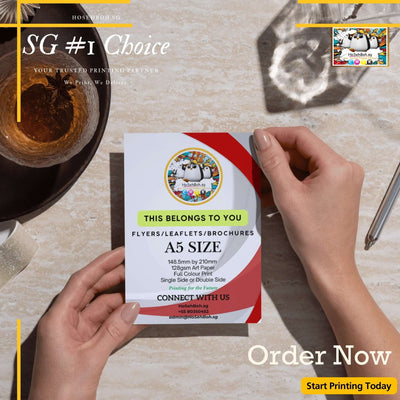
The A5 flyer is your bold statement piece. At 148mm x 210mm, it’s exactly half a sheet of A4 paper. It commands attention. This size converts best for announcements that need visual impact and information density.
Best For: Grand Openings, Major Sales Events, Workshop Sign-ups, Product Launches.
Why it Works: The generous canvas allows for strong imagery, clear headlines, and detailed bullet points. You can show a menu, a map, and multiple product shots. It feels substantial. For a café launching a new brunch menu, an A5 art card printing job on 310gsm stock feels premium and “atas”. It sits proudly on a community board or countertop.
The Singapore Context: High foot-traffic areas like MRT exits or heartland mall entrances suit A5. People have a second to receive it. The perceived value is higher, which can justify a higher perceived value of the offer inside. We often recommend a matte or gloss lamination here. It resists the humidity and constant handling, keeping it crisp.
DL Flyers: The Direct Line
The DL flyer is the workhorse of direct mail and targeted handouts. “DL” stands for “Dimension Lengthwise,” and it measures 99mm x 210mm. It’s the size of a standard bank statement. This is not a coincidence.
Best For: E-voucher deliveries, appointment reminders, targeted promotions, and follow-up materials.
Why it Works: Its familiarity is its power. It looks like something important. It fits perfectly into a standard C6 envelope for direct mail campaigns. The long, narrow format forces a clean, top-down hierarchy of information: logo, headline, key benefit, call-to-action. The conversion path is linear and hard to mess up.
The Singapore Context: Perfect for B2B marketing or high-end service promotions. A dental clinic can send DL reminder cards. A financial advisor can use them for seminar invites. They feel personal, not mass-produced. For corporate use, a textured uncoated stock can elevate this feel further.
A6 Flyers: The Pocket-Sized Persuader
The A6 flyer is the tactical operator. At 105mm x 148mm, it’s the size of a standard postcard or a generous business card. Its entire strategy is based on portability and low commitment.
Best For: F&B discounts, QR code leads, small event invites, bulk handout campaigns.
Why it Works: It’s easy to take. There’s almost no social barrier to accepting one. This size converts brilliantly for impulse offers. A “10% off your next coffee” QR code on an A6 flyer handed outside the shop has a shockingly high redemption rate. The goal isn’t to tell a whole story. It’s to make one irresistible offer and facilitate an instant action.
The Singapore Context: Ideal for weekend promotions in places like Bugis Junction or Clarke Quay. People are out, ready to spend, but don’t want to carry clutter. An A6 flyer with a simple offer and a scannable code is a direct line to a conversion. Durability is key here. A standard 310gsm art card will survive being crammed into a pocket or bag.
The Real-World Data Point: A Local Case Study
Last year, a local fitness studio ran a split test for a new member drive. They designed identical offers for an 8-week challenge. Version A was a glossy A5 flyer placed in nearby condominium lobbies. Version B was an A6 flyer with a prominent QR code handed out at a nearby MRT station during peak hour.
The A5 flyers generated more website visits. The A6 flyers generated more sign-ups.
The reason was friction. The A5 had more information, which led people to “research later” on their phones. The A6 had one call-to-action: scan, see the offer, sign up now. The smaller size created a smaller, faster decision loop. The goal defined the winner.
Choosing Your Weapon: A Simple Framework
Stop asking which size is best. Start with these three questions:
1. What is the single, primary action I want someone to take? (Call, visit, scan, sign up.)
2. Where will this flyer physically live most of its life? (Hand to hand, in a mail pile, on a bulletin board.)
3. What is the perceived value of my offer? (A 50% off pizza coupon feels right on A6. A $5,000 masterclass invitation does not.)
Your answers will point you to the right format. The design and a5 art card printing quality come after. They amplify the strategic choice.
Final Takeaway
The most expensive flyer is the one that never gets a chance to work. Size is the first gatekeeper of your message. A5 for impact and detail. DL for direct and professional communication. A6 for volume and instant action. There is no universal champion, only the right tool for a specific job.
Think about your next campaign objective. Then, match the physical scope of your message to the physical reality of your customer’s day.
Need a tangible comparison? At Ho Seh Boh Group, we provide sample packs. Feel the weight of 260gsm versus 310gsm versus 350gsm card stocks. See how a DL fits in your hand versus an A6. Sometimes the best strategy starts not on a screen, but right in your palm. What’s the main obstacle your next flyer needs to overcome?